



 Loading...
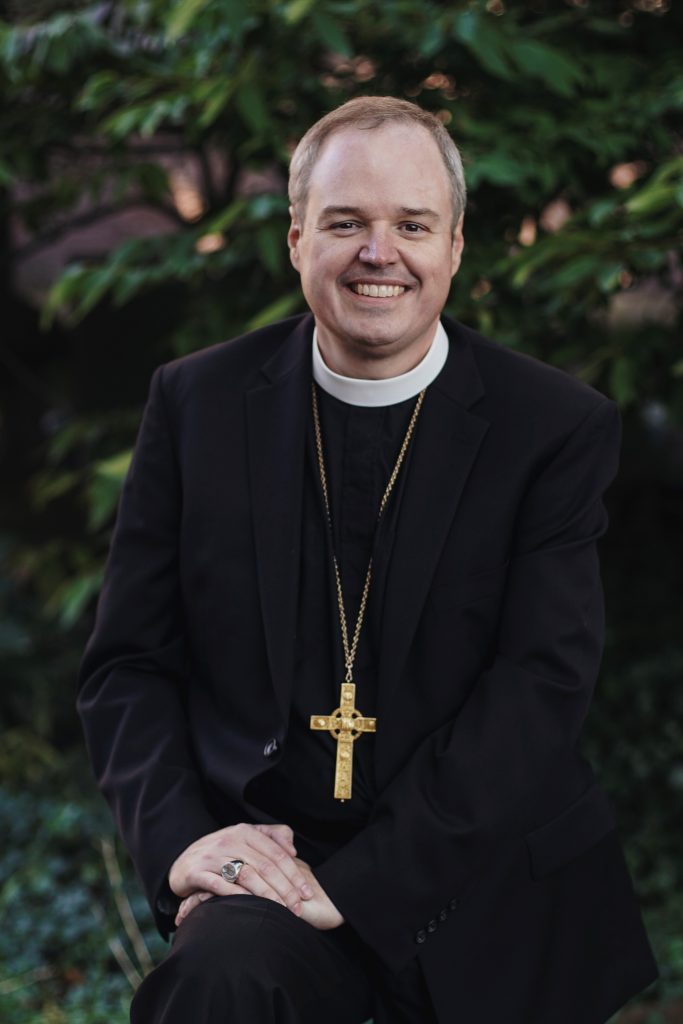
Frank and forward-looking, Bishop Terry White, in his second convention address in nine months, set out five initiatives to help the people of the Diocese of Kentucky in 2012 “discover how to be more effective in feeding, tending and proclaiming” while doing God’s work amid changing circumstances.
The initiatives call for the development of the following: a Christian formation program directed to people new to faith  and the Episcopal tradition; a new canon for funding diocesan ministry that is created with congregational participation; a business plan to “solidify” the ministry at the diocese’s camp and conference center, which has been facing financial challenges in recent years; a series of programs, retreats and lectures to support congregational vitality; and continued work on re-forming and re-tooling diocesan structures for effective ministry.
The bishop gave the address to more than 200 attending Morning Prayer during the 184th diocesan convention, which met Nov. 11 and 12 at St. Andrew’s Episcopal Church in Louisville.
Convention is all about compassion
The second annual gathering to convene this year because the diocese transitioned to a late autumn meeting referenced not only the season but also a national and local movement to recruit communities and individuals pledged to compassionate action (Louisville signed the compassionate cities charter that weekend). The convention theme, “The Fruits of Compassion,” was the subject of workshops, a video shown during the morning business session and a theme in the bishop’s sermon during the opening Eucharist and annual address.
Opening his address with references to the scripture readings for that day and the ordination of seminarian Ben Badgett as a deacon the preceding evening, White began by stressing “that greatness in God’s realm is found in servanthood.” The letter to the Romans, he said, “exhorts us, as the people of the diocese” to share the Good News “in such a clear and powerful way that those beyond the household of faith are compelled to seek out the source of the joy and grace and healing and forgiveness that motivates us.”
Similarly, the gospel reading sends us outside our churches to serve the people in our communities, he suggested in the 30-minute address. “Jesus asks Peter, ‘Do you love me?’ And he asks us as individuals and as the portion of the body of Christ known as the Diocese of Kentucky: Do youlove me? Then feed my lambs, tend and feed my sheep,” White said. “The call to compassion means to feed and tend. Compassion is at the heart of mission, and the heart of parish work, and in this diocesan community.”
The people in our congregations have a strong desire to be servants, he said he has found in his visits. “The challenge is how to re-form our present structures and mind-set so that few financial resources don’t rob us of spirit and enthusiasm.”
 With directness he informed the 128 deputies and clergy members, who would be voting on the 2012 diocesan budget, that the budget includes reductions in funding to the diocese’s three campus ministries because “our overall income is down.” He asked the people of the diocese to seriously take note of the reasons for those reductions and “consider that parish relationships might boost those programs.”
Bishop has five-point plan for action
The five initiatives he outlined are designed to address challenges the diocese and many of its 34 congregations face in our increasingly secular, financially challenged communities.
As his first initiative, the bishop announced that he has commissioned seminarian Katherine Doyle, recently appointed as chair of the Department of Christian Formation, to develop a “Foundations in Faith” program for “those seeking to make a commitment to Christ.” It is needed, he said, by congregations that do not have such a program or the personnel to lead one, and, he also noted, “might help standardize the content of what is being offered those new to the faith and this tradition.”
Addressing financial concerns, the bishop called for the convention and congregations, through the auspices of their deaneries, to discuss and study questions of “money and mission” so that the next November’s convention may adopt a new canon setting out “how to fund our common mission.” Under the current canon, congregations are expected to give between 15 and 20 percent of their net disposable income, but that percentage is not mandated. The canon, the bishop said, “has been something of a blessing and curse” because it has “challenged some congregations to see the importance of supporting ministries” in our diocese but also has generated “a certain amount of suspicion and division and hostility.”
In an effort to “solidify” the ministry and mission at All Saints, the third initiative, White announced that a task force is being formed, under the leadership of the Rev. Canon Joan Smith, to present a business plan to Trustees and Council at their April meeting. “This task force will include people who bring business/finance, forestry, spiritual formation, hospitality, land management/stewardship, and promotion/publicity talents to the task,” he said.
He also identified several programs and retreats that will be held next year to help church leaders develop tools for congregational vitality, and he said the diocese will resume the Brennan Lecture series and the financial stewardship conference.
Bishop White began his address with the humor characteristic of his sermons. “I wish to remind this gathering, that since our last convention, something has changed. On September 25, my one-year full replacement warranty expired. (You can only get a partial refund if you choose to return me to the new bishop warehouse)” he quipped.
Then he added, “Yet, the fact that we have been together for one year, one month, and 18 days means our relationship has lasted over five times longer that Kim Kardashian’s latest marriage. Of course, our relationship has been five times more glamorous!”
After presenting his plan for meeting the challenges, he gave those gathered a snapshot of why it is so important to succeed through the stories of two people who returned to church because of the compassion and welcome they encountered in the Episcopal congregations in their communities. “Feed God’s people with compassion. Tend God’s people and lead them to places where compassion can be shared,” he urged. “Our many communities in this Commonwealth need us.”
[The bishop’s full address may be found at //www.episcopalky.org/dfc/newsdetail_2/3150209]
Another lean budget is approved
The convention approved a lean budget for 2012 as proposed by the Trustees and Council’s budget committee. Totaling  $1,279,056, the budget shows an $28,585 increase in congregational pledging for 2012, but an overall income decrease of $62,090 due to the sustained reduction in endowment spending as mandated by the Trustees and Council and the lack of other revenue sources such as last year’s end-of-the-year surplus and one-time gifts.
Funding of diocesan departments totals $461,771, reflecting a decrease of $32,023 in funds available to diocesan programs and ministries. The increasingly popular camp program was one of few to receive a modest funding increase of about $800. Funding for Christian formation programming was cut by $16,628; evangelism and congregational development, $12,695; justice, Jubilee and health ministries, $2,450 (which is about two thirds of the department budget); and stewardship and congregational development expenses, $250.
What it means
Putting a “face” on the cuts and explaining their significance, Budget Committee Co-Chair Angela Koshewa noted, in addition to the $13,376 cut to the college chaplaincies, that the School of Ministry, “our seminary for lay and diaconal development,” received a significant cut, and she informed convention about items not included in the budget.
“A reading program that would have served a larger mission of the church was taken out of the budget before presented to Trustees and Council,” she said, explaining that program “would bring new people to Christ, and we have no money for it.” Funding to resume printing a quarterly publication also was cut before the budget went to Trustees and Council, she noted. “We are not sharing among ourselves the good news of what we are doing. That is a place where we are not being fed,” she said.
The Rev. Karl Lusk, the other budget committee co-chair, explained the meaning of significant cuts to the Evangelism and Congregational Development budget, which provides for mission funding grants. All churches in the diocese, regardless of size and parish status, are eligible to apply for these grants, which are intended to provide “gap funding” to “help them make their ministry goals a reality.” Grant applicants were asked this year to cut their requests as much as possible, and two congregations, St. James Church in Shelbyville and St. Peter’s of the Lakes in Gilbertsville, not only cut but withdrew their funding requests. In deciding that they are “revitalized” and can do their work without assistance, he said, they captured the vision behind mission funding. The department also provides funding assistance to “aided parishes,” those that can fund at least 75 percent of their expenses and are moving toward self-sufficiency, he explained. One Jubilee Center, the Aaron McNeil House, which provides vital services and emergency assistance to people in the Hopkinsville area, received a budget increase because they lost some United Way funding.
Funding for the diocese’s administrative staff was reduced by nearly half with the elimination of two staff positions (the bishop’s assistant and the office administrator) this year and no provision to replace them. Diocesan operational costs for 2012 total $679,864.
The budget co-chairs also noted the diocese will be giving $118,524 to the Episcopal Church, reflecting a pledge reduction of $2,199. Overall, the diocese’s budget for Episcopal and ecumenical outreach, totaling $137,421, was cut by $11,751.
New Seeds interns are introduced
The five New Seeds interns who are assigned to serve at various ministries in the diocese were introduced to convention by the Rev. Canon Amy Coultas, the young adults missioner at Christ Church Cathedral who is directing local internship program established by the Episcopal Service Corps. Among the interns’ assignments in the diocese, she noted that they are assisting the chaplains at U of L’s Interfaith Center, the tutoring program for refugees at Resurrection Church, St. Andrew’s food pantry assistance at Advent Church, the cathedral office and Aaron’s Work Transition Program, St. George’s Community Center, and the diocesan office and an historical research project investigating the church’s involvement in the Civil Rights Movement and its relationship to slavery.
The convention also applauded, with a standing ovation, an announcement by Anne Veno, the executive director of the Episcopal Church Home, that a “neighborhood” at the home is being named after the Rt. Rev. David Reed, the diocese’s seventh bishop.
In other business, the convention:
- Elected 15 lay and clergy leaders to diocesan committees, boards and offices. (Names of elected officers have been posted online.)
- Approved routine revision changes to the charters of the Bishop Dudley Trustees’ Fund and the Trustees and Council presented by Chancellor Rob Beard as proposed by the diocese’s canons committee.
- Approved a report by Treasurer Don Kohler, who noted that revenue for the first nine months of this year declined $47,000. Although expenses have been reduced by $135,000, he informed the convention, the diocese still has a loss. “The answer I would give to you is this: We need the income side. We can cut, we can eliminate. We have done both. We need the revenue.” The investment committee, he also reported, continues to follow a conservative policy. “Investment is dangerous when it looks most easy,” he cautioned, alluding to gains made this year. “We do have tough times ahead. We are asking for your cooperation and understanding.”
- Announced the committee and board appointments by the bishop (A list of the appointments has been posted online.)
Photos by Don Vish:
Top photo: Bishop Terry White ordains seminarian Ben Badgett a deacon during the convention's opening Eucharist.