



 Loading...
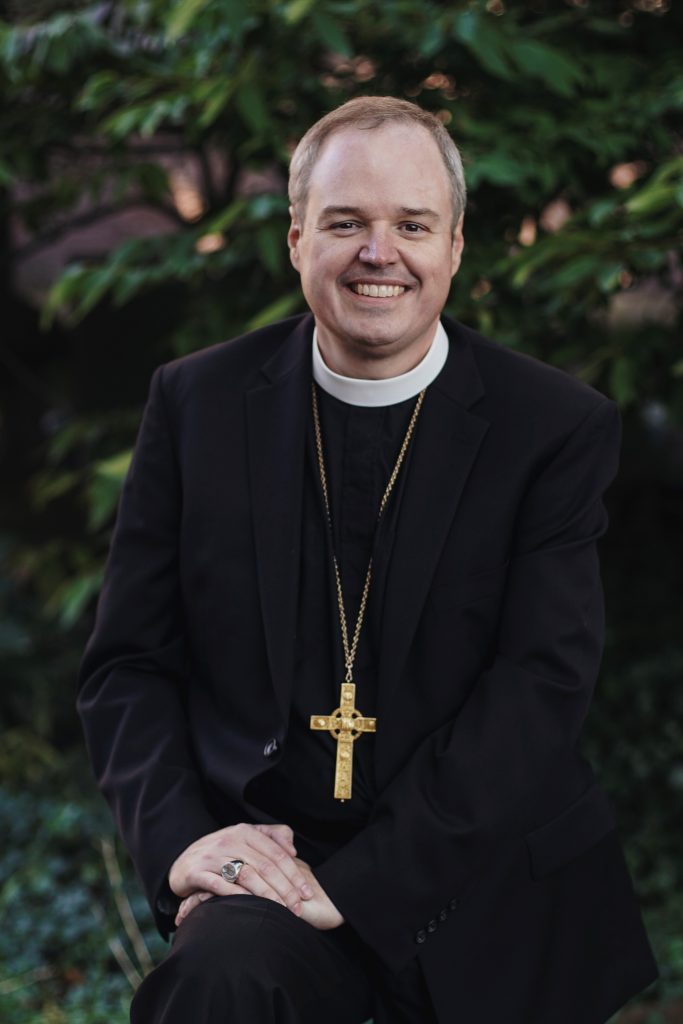
“So what’s new?” the Rt. Rev. Terry White quipped less than 24 hours after his consecration on Sept. 25 as the eighth bishop of the Diocese of Kentucky.
 Having just been allowed to enter Christ Church Cathedral after pounding on its door with his crosier and then officially installed in his cathedra (the bishop’s chair) in a traditional ceremony, White lightened the formality of the moment with humor as he began to give his first sermon in the diocese.
“First I would like to say thank you for letting me in the door. Secondly, you don’t know how tempting it was to knock on the doors, not with my crosier, but with a Louisville Slugger!”
Before addressing the message of that Sunday’s readings, however, White recounted a conversation he had the day before with a “younger member of our diocese” whose “eyes got really big” when the new bishop confirmed his birthday was Sunday. “What do you think you’ll get?” the youngster asked him.
“I’m getting a new chair,” the bishop answered, to which the youngster inquired, “Is it a recliner?”
“Well, will it be a recliner, Mr. Dean?” Bishop White joked, looking at the dean of Christ Church Cathedral, the Very Rev. Mark Bourlakas.
The recollection of their conversation, as heartwarming and light-hearted as it was, acknowledged the newness his episcopacy and his recognition of it as a gift. The image of being gifted with the bishop’s chair, a symbol of his authority as the head of the Episcopal church in the western half of Kentucky, would turn out to resonate with the sermon he was about to deliver in response to the parable of the rich man dressed in purple (an irony the new bishop acknowledged).
He began by referring to the intensely hostile, public dispute over money between former friends and classmates, Mark Zuckerberg, founder of Facebook, and a Facebook co-founder, Eduardo Saverin, their story soon to be seen in the film The Social Network, pointing out that both men recently were listed among the top ten of Forbe’s 400 richest people. According to Forbes, the net worth of the richest people in 2009, grew eight percent, “far exceeding the one percent growth” believed to have been experienced by most Americans, said White.
Rather than point “a judgmental finger” at those on the list, the bishop suggested instead that the congregation visit the website of www.globalrichlist.com, which will show them where their annual income ranks in the world. “It is quite humbling. For instance, if your income is at least $33,750, you are in the top five percent of the wealthiest people in the world. At $47,500, you are in the top one percent.”
The parable of the rich man, “particular to Luke” (16:19-31), White said, “seems to further illustrate the work of God” as told in the first chapter of Luke: “He has cast down the mighty from their thrones, and has lifted up the lowly. He has filled the hungry with the good things, and the rich he has sent away empty.”
Before we rejoice because “someone else is about to get theirs,” however, he said, “we must face the truth that relative to the world’s population, we are unimaginably rich, and God has very clear ideas about what the rich are to do with our abundance of money.”
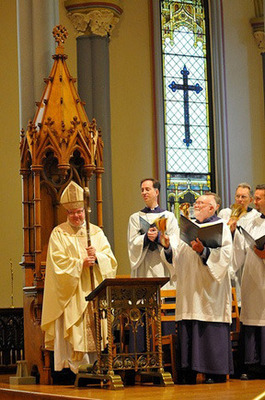
He added unequivocally that this parable applies to churches as well as individuals. It and our baptismal covenant, he said, “demand the Church live into radical servanthood, especially those dressed in purple,” he said.
Statements from two archbishops illustrated what radical servanthood means for him. The first is a famous observation by Dom Helder Camera, Roman Catholic Archbishop of Olinda and Recife, who said that “When I gave food to the poor, they called me a saint. When I asked why the poor were hungry, they called me a communist.” The second, by Archbishop Desmond Tutu, refers to Lazarus, who was content to receive crumbs underneath the rich man’s table. “I am not interested in picking up crumbs of compassion thrown from the table of someone who considers himself my master. I want the full menu of rights” was Tutu’s response. Nor is it any consolation for someone to claim neutrality when injustice is done, said White, quoting Tutu’s observation, “If you are neutral in situations of injustice, you have chosen the side of the oppressor. If an elephant has its foot on the tail of a mouse and you say that you are neutral, the mouse will not appreciate your neutrality.”
Jesus, White suggested, calls us not to just give to those in need but also to lift them up. Churches that make effective servanthood their mission will reap benefits, he said. “People are drawn to congregations engaged in mission, who care for their neighbors, who take the new commandment to love one another seriously.”
Unfortunately, Christianity has a negative image among younger people (16-29), he noted. A survey by members of the Barna Group, which recently published the book unChristian, has shown that young people who were surveyed had three common, negative descriptions of Christianity: anti-homosexual (91 percent), judgmental (87 percent) and hypocritical (85 percent). Only 55 percent viewed Christianity as a “faith you respect.”
Young people are not the only ones who want a community committed to “authentically” following Jesus “by loving their neighbor more than the institution,” “being faithful more than being religious,” and being passionate to serve others rather than maintain the status quo. Our younger members, however, are the best at seeing “the chasm and the need to bridge it,” he added. “This old guy in new purple can learn much from those much younger who speak truth to power and act on their convictions that as baptized disciples we must be servants.”
When we respond to this call to serve, he urged us to remember that, compared to the rest of the Anglican Communion and world, “we are rich, and our Church is rich.” There are great needs in our world, he said, but we have a “mountain of resources” with which to respond. “We need the vision, the eyes to see Lazarus at our gate both around the corner and across the globe. And we need the will to faithfully respond to what we see.”
About 300 well wishers, many from the cathedral in Kansas City, Mo., and cathedral members attended the hour and a half service. Afterwards, they enjoyed a potluck luncheon given especially for the out of town guests who came to Kentucky to see their priest, family member and friend consecrated as a bishop.