


 Loading...
The Episcopal Church's Standing Commission on Liturgy and Music is inviting input and comments about a possible revision of the Hymnal 1982. This comes as a directive from the General Convention "to conduct a feasibility study on the need for revision of the Hymnal 1982 by speaking to congregations, dioceses and all seminaries of this Church, and to report its findings to the 77th General Convention."
[Editor's Note:] To obtain this input, a survey has been prepared that can be completed on line at //www.cpg.org/hymnalstudy2
Further information about the Hymnal Revision Feasibility Study may be found on the Episcopal Church's Office of Public Affairs "Newsline" website. (Please note that the survey deadline of January 31, 2011 mentioned in that article has been extended to April 30, 2011.)
If you have any questions or difficulty logging into the appropriate survey, please send an email to hymnalsurvey@cpg.org
Last, current hymnal revision surveys
Those who remember preparations for the Hymnal 1982 may have completed a survey that asked participants to note their favorite hymns. Hymn number 1 in the Hymnal 1940 was the favorite with number 2 coming in second place. It appeared that some began the process at the front of the book and didn't make it to the back. The primary task of the Standing Commission on Church Music, as it was called then, was to choose beloved texts from the past and to add new ones that also express the faith of the Church. When the proposed hymns were presented to the General Convention in 1982, it was expected that some texts would be deleted and others not included would be restored.
I had the privilege of being a deputy to that convention and my assignment at the hearing on the proposed hymnal was to take note of people's requests. "I sing a song of the saints of God" had not been included but it was clear that church members wanted it in the new hymnal. After deletions and additions the texts were brought to a vote. Only one hymn was added on the floor of convention: "Now the day is over."
The current survey is quite different from the one used for the Hymnal 1982. It does not ask about specific hymns but refers to new musical styles and genres used in congregations today. Back in the 1960's and 70's folk Masses were used in some congregations but "contemporary Christian" music hadn't been invented.
Why participate
Since 1982 there has been a vast change in music for worship. Singing standard hymns found in Protestant hymnals is only one option. Many new texts and tunes have been written replicating the secular pop-culture. The difference is in the text. Diversity is also found in the instruments used for making music. The organ and piano are not necessarily standard. Fewer musicians are learning to play the organ while others have become versatile with electric guitars, keyboards, and drums. As an example, when I was in graduate school in organ at the University of New Mexico there were sixteen organ majors, most of whom had good music positions in local churches. In recent years there have been no organ majors at UNM. This is true for many colleges and universities throughout the country — leaving a dearth of traditionally trained church musicians. In small congregations, like the one I serve in Russellville, the lack of a church musician led to the use of recordings to accompany congregational singing. Finding an accomplished organist in a small town is rare.
I spent 41 years of my ministry in two large congregations, both of which are now cathedrals. They have the financial resources to support fine music programs. In those churches the Hymnal 1982 continues to be a masterful work. Almost all of the music can be used proficiently. Now that I am in a small congregation, however, fine texts with innovative tunes are often too difficult for the average member to sing. This is true for many congregations and is undoubtedly a reason that the Episcopal Church has published additional resources for worship as in Lift Every Voice and Sing, Wonder Love and Praise, and Voices Found to name a few. We worship in an age requiring diversity in language for texts, musical styles and accessibility, and in music that will elicit the song in the worshipper's heart. Planning a musical menu that will appeal to all members of a congregation is another challenge. New music projected on wide screens for all to see in the nave may find favor with some, but for others it is an effrontery to the decency and order due the Deity.
All of this is to say that your participation in the survey will be most helpful to the Standing Commission on Liturgy and Music as they discern the feasibility of a revised hymnal. With the abundance of musical variety in the Church, can each style be represented in a single volume that will fit the pew rack? Will we always need supplements? Should congregations create their own hymnals and pay the royalties through approved licensing? Will the tried and true hymns of the centuries be lost to fleeting musical fads? Can we afford new hymnals? Add your own list of questions, and give the Standing Commission a sample of where you stand.
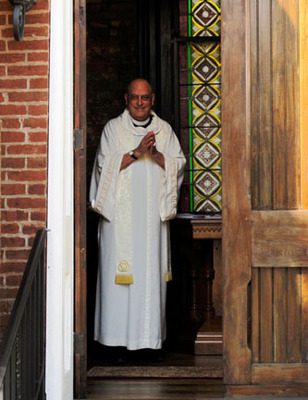
[Editor's Note: The Rev. Dr. Geoffrey Butcher, pictured above, assisted with the revision of the 1982. His profile may be found here. Photo of the Rev. Geoffrey Butcher from Trinity Episcopal Church website.]