



 Loading...
The 182nd Convention of the Diocese of Kentucky approved a $1.5 million budget, elected a new slate of diocesan leaders and adopted a host of resolutions, but this convention was not about business as usual, thanks to the bishop and a panel of young adult Episcopalians who cherish their church and want more from it.
Retiring in September, Bishop Ted Gulick focused his annual address on the convention’s theme “Generation to Generation” and organized a “Generation to Generation Dialogue” as a plenary session that followed so, he reported, those entrusted with electing a new bishop in June could hear from an under-represented group of Episcopalians, the 20-something “Millennials” and their predecessors, the “Gen-Xers.”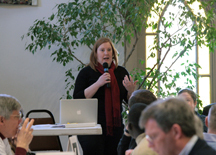
Four priests and three lay members participated in the discussion, described later by several convention participants as the central event of the Feb. 26-27 convention at Grace Episcopal Church, Paducah. The young adults were asked by Bishop Ted Gulick to share their views about their Episcopal identity, church tradition and practices, and their vision for The Episcopal Church.
For 56 minutes, the deputies and clergy heard what young adults like about their church, what frustrates them and what they would like to see it do differently. (An audio recording of the session has been posted online, and DVDs of the video recording will be available to the churches later.)
As one priest, a Millennial herself, reported from the pulpit the next day, the dialogue was “exciting” and important. Not at all reticent, the panelists energized the convention with their direct, enthusiastic and at times passionately delivered answers. They gave the clergy and deputies much to think about.
Picture of Millennials emerges from the discussion
According to the panelists’ accounts, a picture emerged of the Millennial generation as relational and traditional. They typically want to be personally invited to participate in an activity or organization (no “sign up sheets” in the parish hall for them; lists are missing the personal element), panelists said. If they do show up at the church door, "welcome them and give them something to do,” advised the Rev. Canon Amy Coultas, a Gen-Xer who is the youth and young adults missioner at Christ Church Cathedral in Louisville. They are do-ers. Do not assume, however, that they want to do youth ministry; they might prefer to work with the altar guild, suggested the Rev. Hilary Bogert-Winkler, a recently ordained member of the Millennial generation who is the priest associate at Grace Church in Amherst, Mass.
 Coffee hour typically is not an attraction for this group, they said; Facebook is. “If you are trying to reach young people, do not downplay the importance of having a Facebook group for your church,” said the Rev. Matthew Bradley, the other “Millennial” priest on the panel. Facebook, he said, is “free advertising, and relational news. … A ready built apparatus. … You want to talk about a low threat level of evangelism. This is the way to do it.” Bradley is the rector at St. John’s, Murray, and also serves as its campus chaplain for Murray State University students.
Overall, the panelists revealed they like Episcopal tradition. Repeatedly, they mentioned the Book of Common Prayer and the common worship that connects Episcopalians with Anglican churches around the world and across centuries. The Rev. Mitch Bojarski, the new vicar at St. Thomas in Campbellsville who can claim affiliation with both groups, noted his concern that Episcopalians, seeing nondenominational churches’ growth, are abandoning traditional Episcopal worship practices as a response to the pressure of declining membership.
Even as they spoke about their frustrations, they revealed a passionate regard for their church community and ministries.
The Dialogue: A Closer Look
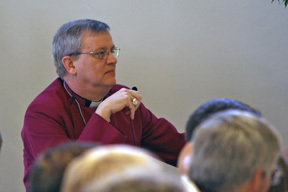
Prompted with questions from the bishop, the panel members talked about what they cherished about their church; what frustrated them and what they wished the church would do more effectively; and if the church “asked enough of them” and valued their gifts.
Following are summaries of the discussion and excerpts of their responses to the questions. Better yet, by clicking on the links you may hear their responses to each of the broad questions in their own words. [Or you may download an audio recording of the entire dialogue.]
Question 1: What do they cherish about their Episcopal identity and church?
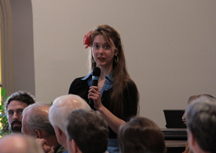
In answering the first question, which asked them to identify what they cherish about their Episcopal identity and church, some said they like the church’s traditional acceptance of difference. Ellie Nolan, a peer mentor with campus ministries at U of L, said she cherishes The Episcopal Church's openness and the Anglican tradition of acceptance of those who are from different backgrounds and those who have different opinions. “As a Christian, I feel like Episcopalians are truly working for that image of God’s peace on earth. The red doors are open. …. Race or color or class or any of those other things that can separate, we truly look beyond that.” She also noted that she appreciates that “we worship all together, using the same liturgy.”
Some pointed to Episcopal Church traditions and liturgy. The Rev. Mitch Bojarski, vicar of St. Thomas Church in Campbellsville, noted, for example, his love for tradition and the Book of Common Prayer, not only because it connects Anglicans but connects us with the “earliest parts of the church. … We are worshipping with all the saints that have come before… I really believe that if St. Augustine came back he would recognize our worship.”
The Rev. Canon Amy Coultas, missioner of youth and young adults at Christ Church Cathedral in Louisville, said she valued the Anglican tradition of taking the “the middle way, not just the historic understanding of that coming together of Catholics and Protestants. Goodness gracious, the world needs to be able to figure out how to come together and find the middle way because we can’t seem to get much done right now.”
The Rev. Hilary Bogert-Winkler, a priest associate at Grace Church in Amherst, Mass., said she appreciated that “we are foremost a Christian community” and the church “provides the liturgical and theological tools to think about what it means to live that Good News.”
Benjamin Hart, a student at Murray State Univeristy and peer minister in the campus ministry at St. John’s Church, noted that he appreciates the way Episcopalians engage scripture in Christian formation classes such as Education for Ministry, where hard questions are welcome and easy answers not given.
Question 2: What are their frustrations and hopes?
The second question, which asked what frustrated them about the Episcopal Church, and what would they like to see it do more effectively, brought answers that revealed their passionate regard for the church and their place within it.
The clergy panel members listed several concerns that discourage or interfere with clergy and lay ministry: the under funding of young adults ministries; the reliance upon a numbers-based business model for measuring success; and the under use of laity and the over-dependence upon clergy and lay employees.
As churches are now structured and managed, the Rev. Matt Bradley said, they are not “developing their members into disciples.” Being a Christian is “the way you live your whole life,” he said. “I don’t think we give them discipleship … We have them looking to the clergy for answers, to provide programs, to start ministries. The impetus should come from the laity.”
Relying on clergy and lay employees to do multiple jobs is another problem, noted Bradley, who is rector of St. John's Church in Murray and chaplain of its campus ministry for Murray State University students. “Unlike any group in the world that is effective, we expect our employees to do multiple fulltime jobs … and that’s for lay and clergy alike. I will speak for myself personally. I am a one-third time campus minister and a two-thirds time rector, and every week I feel like I do a bad job … because I can’t do them fully.”
Bogert-Winkler also pointed to the business model that the church uses to define success. “Success and numbers don’t fit together with me. If I only have three people in bible study, and if I’m really helping to form three really solid Christians, that means more to me than having 20 people who are just there,” she said.
Nolan and Hart are involved in peer ministry through their respective campus ministries, and both indicated their desire for the church to be involved in outreach ministries.
Question 3: Is the church asking enough from them?
 The third question asked them to reflect on whether the church was “asking enough” from them, if they felt valued and how they have shared their gifts with the church. Nolan gave an enthusiastic yes. Coultas, she said, has encouraged her involvement and she has felt empowered by the church. By way of example, she noted that Coultas recently embraced her idea to have a prayer-a-thon to raise money for Haiti and, as a result, the event will be held Saturday, March 6 at the cathedral.
Tellingly, a lay panel member, Jennifer Dulaney, revealed a problem that Coultas later pointed out has been shown in church research studies to be the reason persons under 30 leave the church. While an undergraduate at Western Kentucky University, Dulaney was an active member of Christ Church’s campus ministry, serving as a peer minister for two years. The 2009 graduate, however, reported that she now feels alone and misses having a group at church in her age range. Young adults’ groups, she said, can become dominated by those who are in their 30’s, are married and have children. “I’m not married. I don’t have kids. I don’t fit in with a college group. … I just want something where you don’t feel all alone.”
What researchers are saying about Millenials
Stressing the importance of including the views and needs of Millennials in the electors’ discernment process, the bishop and Coultas both pointed to a recently released, comprehensive PEW research study on the Millennial generation.
Millennials are more likely than previous generations to be unaffiliated with a particular denomination, but the report also revealed this group has “traditional understandings of Christianity,” said Coultas. “They like for us to talk about the essentials of being a Christian. They want to talk about believing in the resurrection of Christ …. They want to know what we have to say about that. How we experience that, how that gives us life.”
That the church should invest in their youth and college-aged young adults is also borne out by statistics, according to Coultas. She noted that studies have shown that those who were involved in church between the ages 18 and 22 were “94 percent more likely to still be in church” at age 30, she said, adding, “and then they’ll get married, have kids and be hooked.”
The reports also suggest the Millennials are interested in developing their faith life. Coultas said “76 percent self-reported that they want a deeper relationship with God.” They want to understand what faith means in their life, she said. “The major reason they fall away is not doctrinal or political. Simply, they had a life change and were not followed up with.”
Coultas finds good news in these reports, especially that young adults want a “more traditional” church experience. The non-denominational, “emergent” churches that have been successfully attracting young adults must create their liturgy, she noted. Episcopal churches already have in place traditional liturgy, which is not lost on some of the emergent churches. One such church in Louisville that she visited, she said, has taken its liturgy directly from the Book of Common Prayer.
The appeal of traditional liturgy with this group was recently demonstrated on Ash Wednesday at U of L, when 200 students sought out “our ecumenical ministries” to “pray for God’s mercy in our lives,” she said. “I put ashes on their head and helped them remember they are going to die, and they looked at me and said, ‘thank you.’ They live in this world. They know life is hard. They want to be engaged in the most difficult questions.”
[An audio recording of the dialogue has been posted online, and the communications office is planning to produce a video of the session that will be made available to the churches. All photos were taken by Dan Songer, a member of Grace Episcopal Church, Paducah. More of his convention photos may be found here.]